India is one of the top three sources of textile machinery for Bangladesh. According to trade data from 2024, India exported approximately USD 31 million worth of textile machinery to Bangladesh in that year alone. The trade corridor between India and Bangladesh is well established, the shipping routes are predictable, and the documentation requirements are understood by customs agents on both sides of the border.
If you are a fabric manufacturer, textile mill, garment factory, or fabric distributor in Bangladesh who wants to import a fabric inspection machine from India, this guide takes you through the complete process from finding the right manufacturer to getting the machine running on your factory floor.
China supplies about 50 percent of textile machinery imported by Bangladesh. India supplies around 17 percent. Europe supplies the rest. Each source has a different profile and buyers make the choice based on what matters most to their operation.
Chinese machines are the cheapest. But quality varies a lot across different Chinese manufacturers and after-sales support for Bangladesh buyers is usually limited to slow email responses. When a machine breaks down mid-production and you need a technical answer now, email support with a 24-hour turnaround is not useful.
European machines are excellent quality but the prices are very hard to justify for most Bangladesh fabric mills. The economics do not work unless you are running a very large operation that can absorb a premium machine cost.
Indian machines hit the middle. Price is competitive. Quality is consistent. The geographic distance is short, so shipping is faster and spare parts arrive within days rather than weeks. Communication is straightforward because Indian manufacturers work in English and understand the South Asian production environment. When a Bangladesh factory in Narayanganj needs a spare part or has a technical question, the response from an Indian manufacturer is much faster and more practical than from a supplier in Zhejiang.
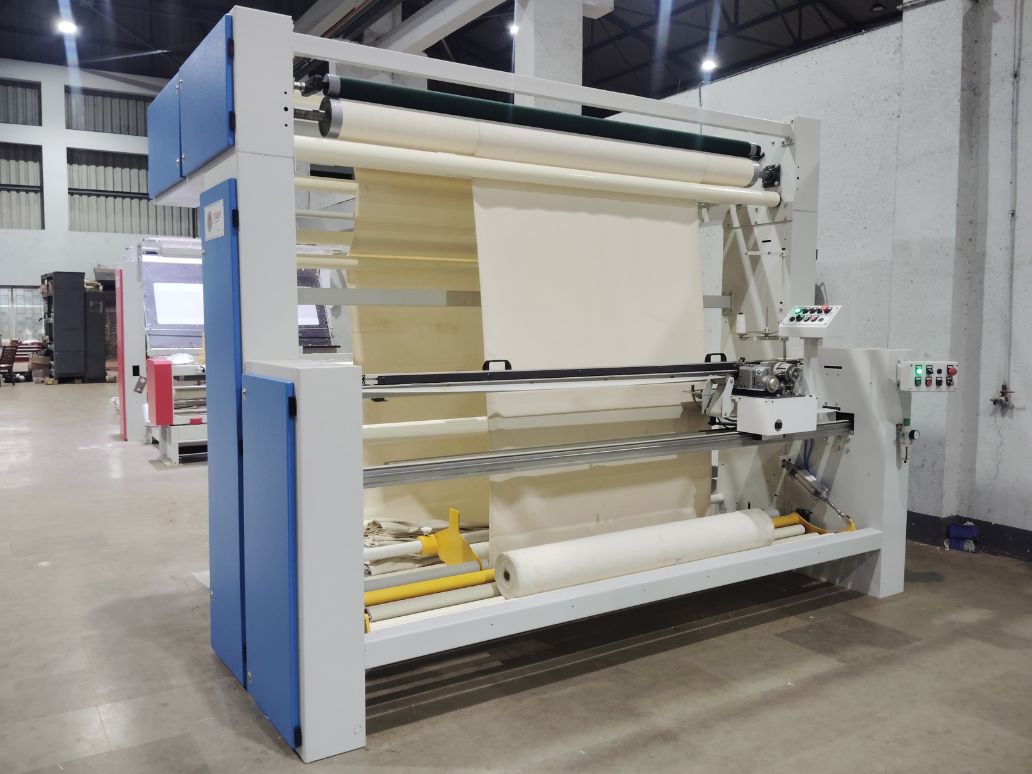
Before you contact any manufacturer, know exactly what your factory needs. What type of fabric do you inspect: woven, knit, denim, tubular, or a combination? What is the maximum width of fabric you work with? Do you need a basic machine with a manual counter or a fully equipped machine with a digital 4-point counter, defect marking pen, and roll report printer? Do you need a cleaning or brushing unit for dusty fabrics like denim?
Getting the specification right before you start the procurement process saves a significant amount of time. The wrong machine for your fabric type will not give you accurate results, and sending back a machine from Bangladesh to India for the wrong specification is expensive and time-consuming. Sit with your quality manager and write down the fabric types you inspect, the widths you work with, and the daily inspection volume before reaching out to manufacturers.
Contact two or three Indian fabric inspection machine manufacturers and ask for a formal pro-forma invoice. A proper quotation should include the machine model and full specification, the FOB price from the Indian factory, estimated production time, payment terms, warranty coverage, and information on spare parts availability.
Do not compare manufacturers on machine price alone. Compare on total delivered cost, which includes freight from India to Chittagong port, insurance, customs duty, VAT, and local delivery to your factory. A slightly cheaper machine with a longer production time, weaker warranty, and no Bangladesh customer references may turn out to be the more expensive choice once everything is factored in.
Always ask each manufacturer for references from existing Bangladesh customers. Call those references and ask about machine performance, spare parts availability, and the quality of after-sales support. That conversation will tell you more than any catalogue or sales pitch.
The most common payment structure for Indian textile machinery exports to Bangladesh is 30 percent advance payment with the purchase order and 70 percent payment before the machine ships. This can be by bank wire transfer or by Letter of Credit. Some established manufacturers accept 100 percent LC at sight.
Always pay directly from your company bank account to the manufacturer bank account as stated on their official pro-forma invoice. Do not make payments to an agent or intermediary account. Get a formal purchase order acknowledgement and payment receipt from the manufacturer before your advance payment leaves your account.
Before the machine ships, ask the manufacturer to run a factory acceptance test with your fabric type. This means they put a sample of your fabric on the machine and run it to confirm everything works correctly. If you cannot travel to India for this, ask for a video recording of the machine running and a signed quality check confirmation from the manufacturer.
If anything is wrong with the machine setup or calibration, it is much easier and cheaper to fix it at the manufacturer facility in India before shipping than to deal with it after the machine arrives in Bangladesh.
The Indian exporter is responsible for providing the following documents for customs clearance at the Indian port of export. Make sure you receive all of these before shipment.
Commercial Invoice in at least two copies, Packing List, Certificate of Origin from the relevant Export Promotion Council or Chamber of Commerce, ARE-1 form for export under GST zero-rating, Bill of Lading or Airway Bill, Insurance Certificate if you are on CIF terms, and a Technical Specification document or machine manual.
The machine needs to be classified under the correct HS code. Most fabric inspection machines exported from India to Bangladesh fall under HS 8445 which covers machines for preparing or spinning textile fibres. Ask your Indian supplier and your Bangladesh customs agent to verify the specific HS code for your machine type before shipment because the customs duty rate depends on it.
The most common route is road transport from the manufacturer facility to Kolkata or Haldia port, then sea freight from Kolkata to Chittagong port. Sea transit is 5 to 7 days. Port clearance at Chittagong adds 3 to 7 working days depending on queue times.
For smaller machines, air freight from Mumbai or Kolkata airport to Dhaka is an option and gets the machine to you in 2 to 3 days of transit time, but freight cost is significantly higher than sea freight. For a machine weighing 500 kg or more, sea freight almost always makes more sense economically.
Some buyers use the Benapole land border crossing from West Bengal into Bangladesh for road freight. This is sometimes cheaper for heavy machinery but customs clearance at land borders can be unpredictable in terms of timing. Most experienced importers prefer the Kolkata to Chittagong sea route for machinery because the documentation process is well established and timelines are more predictable.
Your Bangladesh customs agent will file a Bill of Entry at Chittagong port or the relevant land port using the shipping documents provided by your Indian supplier. The key information needed is the HS code, the CIF value of the shipment, and the country of origin.
Bangladesh applies Customs Duty, Supplementary Duty, VAT and Advance Income Tax on most imports. For textile machinery classified as capital machinery, Bangladesh offers reduced or exempted Customs Duty rates for registered RMG factories under the government capital machinery import scheme. The exact duty rate depends on the HS code and your factory registration status. Verify the current rate with your customs agent or check with the Bangladesh National Board of Revenue before you finalise your total cost calculation. The VAT on import is 15 percent on the CIF value plus duty. The Advance Income Tax is 5 percent and is adjustable against your company tax liability.
Once the machine arrives at your factory, the manufacturer should provide a technical manual and a step-by-step installation guide. Most Indian manufacturers can commission the machine remotely by video call with your factory electrician and maintenance team. The installation itself usually takes one to two days for a standard inspection machine.
For more complex setups or integrated packing lines, some manufacturers offer on-site commissioning visits to Bangladesh. Ask about this at the quotation stage and get it written into the purchase order if you need it. Remote commissioning by video call works well for standard single-machine setups. If you are setting up an integrated line connecting inspection, packing and labelling, on-site commissioning is usually worth the extra cost.
Ask whether they have existing customers in Bangladesh and whether you can get a reference contact. Ask how long spare parts take to reach Bangladesh. Ask whether they provide remote installation support by video call. Ask what their production lead time is from order confirmation to machine ready for shipment. Ask whether they can provide all export documents including Certificate of Origin. Ask whether the machine can be customised for your specific fabric width and inspection speed.
Yash Textile Machines answers yes to all of those questions. We have been manufacturing fabric inspection machines since 1999 and we supply to Bangladesh fabric mills and garment factories with machines running in Dhaka, Gazipur, Chittagong and Narayanganj. We provide all export documents, ship via Kolkata to Chittagong, and give spare parts delivery to Bangladesh within 3 to 5 working days by courier.
Visit www.yashtex.com/fabric-inspection-machine-bangladesh/ or email sales@yashtex.com to request a quotation for your Bangladesh factory.